Attention A T users. To access the menus on this page please perform the following steps.
1. Please switch auto forms mode to off.
2. Hit enter to expand a main menu option (Health, Benefits, etc).
3. To enter and activate the submenu links, hit the down arrow.
You will now be able to tab or arrow up or down through the submenu options to access/activate the submenu links.
Locator
Contact
Search
Search



VA »
Health Care »
PTSD: National Center for PTSD
» Providers
»
Using the PTSD Treatment Decision Aid with Your Patients
PTSD: National Center for PTSD
Menu





Using the PTSD Treatment Decision Aid with Your Patients
Using the PTSD Treatment Decision Aid with Your Patients
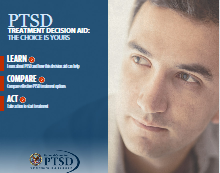 The PTSD Treatment Decision Aid is an online tool to educate people with PTSD about effective treatment options and encourage them to participate actively in decisions about their care.
This tool offers comprehensive information on first-line, evidence-based PTSD treatments identified in the VA/DoD Clinical Practice Guideline, including:
- Antidepressants (SSRIs and SNRIs)
- Cognitive Processing Therapy (CPT)
- Eye Movement Desensitization and Reprocessing (EMDR)
- Prolonged Exposure (PE)
Key Features
Using the PTSD Treatment Decision Aid, your patients can:
- Learn the basics about each of the featured evidence-based treatments, including what they would be asked to do in the treatment, how long it lasts, and how well it works.
- Watch videos of expert clinicians describing each treatment in clear and simple language.
- Compare the treatments they like the most in a personalized chart that helps them see how different treatments measure up to one another and to their own preferences.
- Find answers to some of the most common questions about PTSD treatment, such as: Can I get PTSD treatment if I am drinking or using drugs? Or, will I have to talk in detail about my trauma?
- Get helpful tips on how to work with you to make decisions about their PTSD care.
Continuing Education Course
See the accredited online course Shared Decision-Making for PTSD. It provides information on and a practical model for shared decision-making for PTSD treatment.
You May Also Be Interested In
VA/DoD Clinical Practice Guideline for PTSD (2023)
Get information on evidence-based treatment recommendations for PTSD.
Clinician's Guide to Medications for PTSD
Get key information and guidance on the best medications for PTSD.